Question 1.
Jill’s Christmas decorations included a mix of golden and silver balloons. One of the golden balloons burst reducing the fraction of golden balloons from a third to a quarter. How many balloons were left?
Solution
Suppose that there were t balloons left, of which g were golden, then:
t + 1 = 3(g + 1) i.e., t = 3g +2
t = 4g
So, 4g = 3g + 2 or g = 2
There were 4g = 8 balloons left of which 2 were golden and 6 were silver.
Question 2.
Bill decided to take his mobility scooter at a steady pace of 2mph up his street to look at the Christmas lights. It started to rain so he returned back down the street at a swifter 4mph. What was his average speed?
Solution
If the distance travelled up the street is d miles then the times up and down the street are d/2 and d/4 hours.
The total distance covered is 2d miles in time d/2 + d/4 = 3d/4 hours.
The average speed was 2d/(3d/4) = 8/3 = 2 2/3 mph.
Question 3.
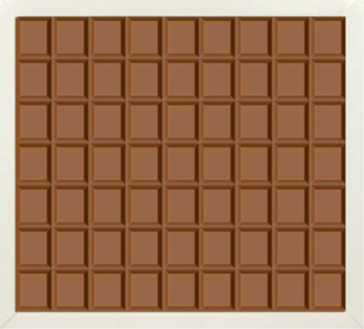
A brother and sister have been given this large bar of chocolate as a Christmas present. There are 63 squares of chocolate however, so the siblings need to decide which of them will get 32 pieces, leaving the other with just 31.
They agree to play a game, taking it in turns to break the bar along one of the troughs. They toss a coin to decide who will go first, and the brother wins. He breaks the bar into two pieces, then his sister chooses one of the pieces and breaks it along a trough. It is then the brother’s turn again, and so on.
The game continues until no more breaks can be made, and the winner of the extra square is the sibling who makes the last break. Who will win?
Solution
Each break causes the selected piece to be split in two, which increases the total number of pieces by one.
At the end of the game there will be 63 single pieces, which requires 62 breaks. As the brother made the first break and 62 is an even number, the sister will be the winner.
Question 4.
Mum has made five Christmas crackers. Three of them are for her children and each of these crackers contains a child’s toy. The other two crackers contain a gift for adults. Unfortunately, she hasn’t labelled the crackers and they all sound the same when she rattles them. She therefore selects the crackers at random and places one cracker at each of the five table settings. What is the probability that at least one of the adults gets an adult’s gift when their cracker is pulled?
Solution
If A represents a cracker with an adult’s gift and C represents a cracker with a child’s gift, the ways in which the crackers could be placed at the five table settings are: AACCC, ACACC, ACCAC, ACCCA, CAACC, CACAC, CACCA, CCAAC, CCACA and CCCAA. If the first two table settings are for the adults then, as the first two letters in the first seven ways listed include at least one A, there is a seven in ten chance that at least one adult gets an adult’s gift when their cracker is pulled.
This also applies for any two settings for the adults – for example, if the last two settings are for the adults, there is at least one A in the final two letters of all but the first, second and fifth of the ten ways listed.
Alternative approach
The probability that the first adult gets a child’s toy is 3/5. The probability that the second adult also gets a child’s toy is 2/4 or 1/2. So, the probability that they both get a child’s toy is 3/5 x 1/2 = 3/10, which means the probability that they don’t both get a child’s toy is 7/10.
 Seaham and District Area U3A